.avif)

Introduction
SaaS website development has evolved far beyond launching a picture-perfect homepage. In 2026, your SaaS website is directly responsible for customer acquisition, activation, and retention.
Moreover, the SaaS website design standards have shifted substantially with the rising competition, AI-driven user expectations, and the growing adoption of no-code tools. Wondering how you can keep up with this change?
Don’t worry! This blog by LikeButter Digital will break down it all through the top 5 SaaS website development trends that are shaping 2026. This guide is sure to help whether you’re using a SaaS website builder or investing in full SaaS website design services.
Here’s what the top 5 trends of 2026 Saas web development include:
1. Conversion-First SaaS Website Design
In 2026, SaaS website design isn’t judged by its visuals alone. It is judged by one thing: Does it drive trials, demos, and sign-ups? If your SaaS website doesn’t communicate value within seconds, the users move on.
This has led to a clear shift, from brochure-style layouts to interactive, product-led experiences. This makes your website the first version of your product instead of a pitch deck.
A high-performing SaaS website design is thus completely focused on conversions. Here’s how you can achieve this too:
- Each page of yours should have one clear core CTA.
- Make sure to show a clear value proposition.
- Minimize the fields in signup forms, providing social login options will further help with abandonment.
- Place the social proof exactly where the decisions are made.
- Ensure you have a mobile-friendly design.
- Use micro-demos to show your product in action.
- Keep your pricing transparent and easy to find for users.
What conversion-first SaaS websites look like in practice:
- Interactive demos without forced sign-ups.
- Onboarding-style landing pages.
- ROI calculators and live product previews.
Why this matters in 2026
- Customers have a much shorter attention span.
- The customer acquisition costs are quite high.
- Users expect value before committing.
Your Saas Web design should thus not only be user-friendly but needs to be clear, responsive, and provide value quickly.
2. Personalized & AI-Driven User Journeys
The generic SaaS websites are losing their effectiveness these days. AI is clearly leaving its mark here too by enabling better personalization through deeper data insights.
This AI-based personalization for modern SaaS web development helps to adapt your content based on the:
- Industry
- Company size
- Traffic source, and
- Funnel stage
So, instead of a static homepage, successful SaaS websites now deliver dynamic experiences. This enables a customized experience to all- be it the founders, marketers, or developers.
Here’s how this personalization looks like in practice:
- Founders see growth and scalability messaging.
- Marketers see attribution, analytics, and ROI.
- Developers see integrations and technical flexibility.
This tailored experience is further supported by smart CTAs that replace generic buttons. These guide the users toward the next step -demo, trial, or deeper content.
3. No-Code & Low-Code Tools are Powering Faster SaaS Website Development
Gone are the days when you had to code for months on end to build a SaaS website. With Low-code and No-code (LCNC) tools you can build a website in a few days and that too with little to no coding knowledge.
This drag and drop SaaS web designing gives a serious competitive advantage with its faster speed-to-market. It is a great option for MVPs (Minimal Viable Products) and supports faster iteration without depending on heavy engineering.
What has changed with LCNC?
- Marketing teams no longer need to wait on developers for updates.
- Website experiments can be launched fairly quickly.
- Iteration costs drop significantly.
SaaS website builder vs. custom builds
- SaaS website builders work best for speed, testing, and early to growth stage teams.
- Custom builds still make sense for complex, deeply integrated products.
It is thus important to understand your needs first and then choose the Saas website builder wisely.
4. Webflow Becomes the Go-To Platform for SaaS Websites
Wordpress has reigned as the prime choice for website development for decades, this is however changing in 2026. A LCNC platform, Webflow, has now become the go-to platform for building SaaS websites.
Why Webflow for SaaS Is Dominating
Here’s why Webflow has become the top choice of SaaS website designing:
- It has enterprise-level hosting, security, and compliance.
- It offers design flexibility without sacrificing on performance.
- It has clean CMS structures that support scalable SaaS content.
- Marketing teams can now ship updates without any developmental bottlenecks.
- Strong SEO foundations are built into the platform.
- It seamlessly connects with CRM, analytics, and automation tools, promoting unified workflows.
Webflow is winning because it strikes that perfect balance between speed and control, an ideal choice for modern SaaS website development.
Using Webflow SaaS Templates the Right Way
The pre-designed, Webflow SaaS templates are a powerful starting point but they shouldn’t be used straight out of the box. Customizing these templates is necessary to avoid a generic design, poor brand identity, and potential SEO issues.
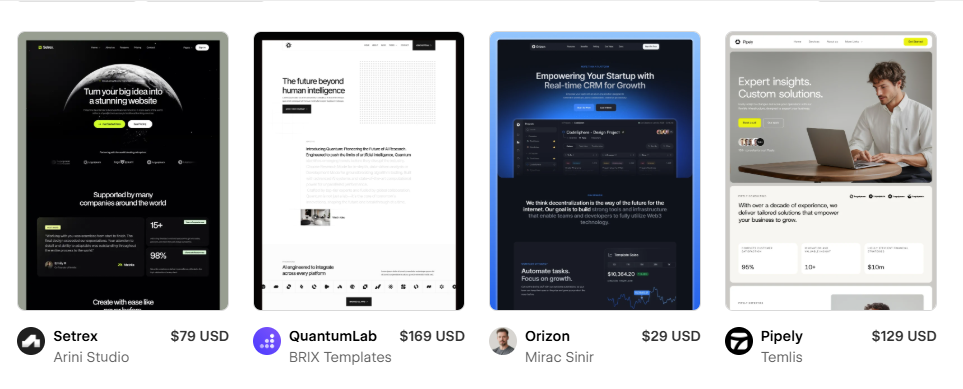
At LikeButter Digital, we understand this and customize your Webflow SaaS templates to:
- Match your brand positioning and voice.
- Support your conversion-first SaaS website design.
- Scale as new features, pages, and use cases are added.
- Ensure a responsive, cross-device performance.
- Leverage built-in CMS and dynamic content structures.
- Align interactions and UX flows to user intent.
A properly built Webflow site thus grows with your product instead of limiting it.
Thinking about switching to Webflow or rebuilding your SaaS site?
Contact LikeButter Digital for conversion-focused, SaaS website design services, built to scale with you.
5. SEO-First SaaS Website Development (without Killing UX)
Building an SEO-optimized SaaS website doesn’t mean sacrificing the user experience, in fact, strong UX boosts SEO performance.
Search engines like Google increasingly reward sites that are easy to use, fast, and relevant. So, a strategy that integrates SEO with UX leads to both better rankings and happier users.
SEO Is No Longer just Blogs and Keywords
SEO in 2026 is no longer bound to blogs and keywords. Your entire SaaS website structure also has a role to play in the organic visibility. This includes your page hierarchy, internal linking, and how use cases are presented.
What SEO-first, SaaS website development includes:
- Use-case pages aligned with real search intent.
- Industry-specific landing pages.
- Integration pages for high-intent traffic.
- Clean internal linking that supports discovery.
- Fast, mobile-optimized performance.
Why this works:
With SEO and UX working together, your SaaS website becomes a predictable growth channel. It works to:
- Promote long-term organic growth.
- Bring in higher-quality inbound leads
- Lower the dependency on paid ads.
- Improve conversions through clearer, intent-focused experiences.
Performance, Accessibility & Trust Matter More than Ever
Users have zero patience for slow or unreliable SaaS websites and search engines are equally unforgiving. This is why modern SaaS website development places performance, accessibility, and trust at the core of their user experience.
High-performing SaaS sites are thus built to deliver:
- Lightning-fast load times across all systems (tablet, desktop, and mobile).
- An uncompromised, seamless, mobile-first experience.
- Accessibility-friendly layouts that work for all users.
- Trust signals thoughtfully integrated into the design (from security badges to transparent messaging).
Performance and trust are no longer optional enhancements in 2026. They are foundational requirements for SaaS websites that want to rank well, convert consistently, and earn long-term user confidence.
When to Invest in SaaS Website Design Services
With the advantages of LCNC clear, you must be considering using the Webflow drag and drop to DIY your SaaS website. And while Webflow makes it easier than ever to get something live, many SaaS teams quickly realize that launching a site isn’t the same as building one that performs.
Signs that You’ve Outgrown DIY
- Your website no longer reflects your product’s value.
- Marketing updates require developer intervention.
- Conversion rates have plateaued.
- SEO growth has stalled.
All these bottlenecks necessitate the partnership with the right website builder for SaaS.
Choosing the Right Partner for 2026
The right SaaS website design services partner understands:
- Product-led growth.
- Conversion-driven UX
- SEO and performance.
- Platforms like Webflow for SaaS.
They understand your needs, have the expertise on the latest technological advancements, and prior experience of working with the SaaS industry. All this helps to design a SaaS website that’s unique to your product and scales effortlessly as you grow.
Final Thoughts
In 2026, successful SaaS website development is about more than just looking good. It’s about guiding users, proving value fast, adapting intelligently, and supporting growth across marketing, sales, and product.
If your SaaS website hasn’t evolved with these trends, it’s likely costing you demos, trials, and momentum. Partnering with the right SaaS website builder is hence essential. If you are ready to take the leap to growth in 2026, LikeButter Digital is the only agency you need. Our SaaS website design services combine strategy, Webflow expertise, and bring measurable growth.







_%20The%20Definitive%20Guide%20for%20Growing%20Brands%20(1).avif)